
We Call It a Team. That Doesn’t Make It One.
Mindset Insights

Mindset Insights
By: Brandy Brown
Add your custom CSS code below
In sports, a team is a requirement.
In the military, a team is a requirement.
In the civilian workplace, a team is a facade.
In environments where a team is real, it’s not up for interpretation.
You don’t succeed alone.
You don’t fail alone.
The work forces dependence.
Not as a preference—but as a requirement.
If one part breaks, the system feels it.
That kind of team doesn’t happen because people try harder.
It happens because the system requires it.
Ownership sits at the outcome—not just the work.
Success is shared. So is failure.
You still operate independently.
But not in isolation.
Your work is yours—but it lives inside something bigger.
And that changes how success works.
You can stand out.
You can be exceptional.
You can be recognized, rewarded, promoted.
But that recognition comes from contribution to the shared win—
from the people most affected by your work.
Not just visibility.
Not just perception.
Not just who tells the best story.
It also changes how failure shows up.
You don’t get left alone in it.
When you struggle, you’re supported.
Not carried—but supported.
Because your outcome affects theirs.
And you do the same in return.
That creates a different kind of accountability.
You’re responsible for more than your work—
you’re responsible for how your work lands, how it’s used, and what happens next.
More coordination.
More friction.
The kind most systems try to remove.
And that’s the point.
The structure doesn’t eliminate independence—
it makes it interdependent.
And that doesn’t stop at a single team.
In environments where this works, teams don’t operate in isolation.
Multiple teams function as a team.
Because the system aligns them—
and requires them to.
No one team can succeed on its own.
→ So there’s no incentive to try.
Misalignment isn’t tolerated.
→ One group can’t optimize at the expense of another.
That alignment isn’t created at the team level.
It’s built into the system.
Which means it has to exist all the way up.
A real team will support you.
But it won’t carry you indefinitely.
If you’re struggling, people step in.
They help.
They adjust.
Because your outcome affects theirs.
But if the gap doesn’t close, something changes.
No one moves forward without consequence.
Players get benched.
Replaced.
And it’s not just individual contributors.
If performance doesn’t convert—if adjustments don’t land—
coaches and leaders don’t keep their jobs either.
You don’t get to stay misaligned while others compensate.
Because the system can’t absorb it.
Real teams don’t confuse support with tolerance.
In the civilian workplace, it’s different.
Consequences are often delayed, softened, or avoided.
And sometimes, that’s how people get ahead.
And the system continues.
We call it a team.
The structure suggests it.
The language reinforces it.
But the way it operates tells a different story.
The goal isn’t as shared as it sounds.
So people adjust.
Not because they don’t want to work as a team—
but because the system doesn’t require it—
and doesn’t reward it.
And over time, that gap becomes invisible.
The language stays the same.
The structure looks the same.
But the behavior shifts.
When goals aren’t truly shared,
work fragments.
When outcomes aren’t shared,
progress stays contained.
Even at the smallest level, teams aren’t required to function as teams—
let alone across teams.
So innovation becomes local.
But without alignment, it doesn’t compound.
You’ve seen this play out.
Look at something like Copilot.
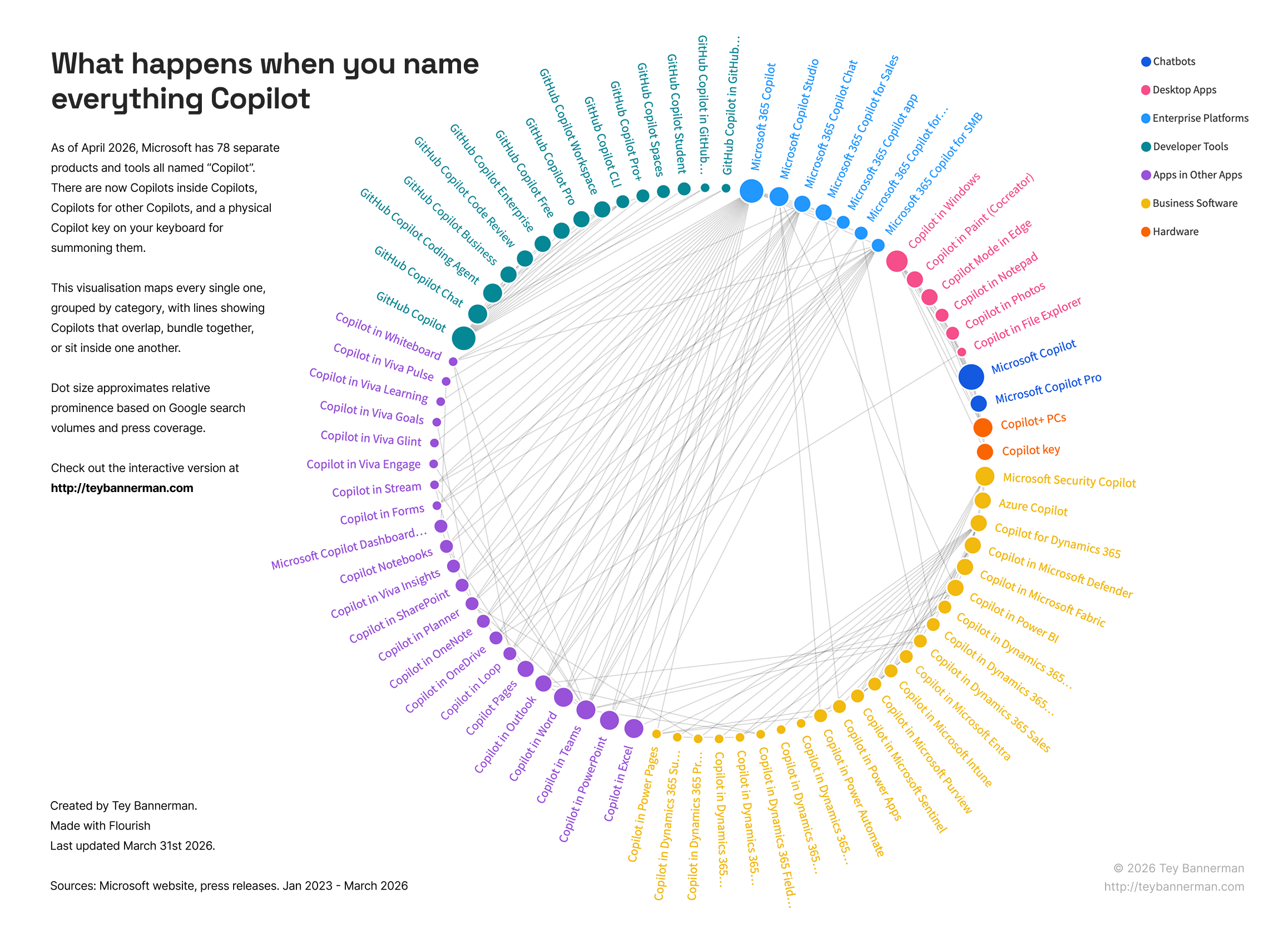
▸ Credit: Tey Bannerman (interactive version)
This is what happens when dozens of teams move forward at once—
without a truly shared goal.
Even internally, it becomes hard to understand what exists,
what overlaps,
and how it all fits together.
That’s not a lack of innovation.
It’s what innovation looks like
when it doesn’t operate as a system.
And quality suffers too.
Because disconnected work creates gaps—
handoffs break, assumptions drift, systems don’t quite hold together.
When the system requires real teams—
not just within a group, but across them—
Innovation doesn’t just happen.
→ It compounds.
Quality isn’t inspected in later.
→ It’s built in from the start.
Most people reading this are inside the system — not above it.
And that's worth understanding.
Stop blaming yourself for how it feels. The system is working exactly as designed.
But for those who can actually change it. Those who have the authority to align incentives, share outcomes, and build real accountability into the structure, I challenge you to do it.
Not because it's easy.
Because it's the only way to build the best products your users will actually love.


